Posts

Showing posts with the label Engineering

S2000 Torque Specs (from S2KI)

Torque specs S2000 AP1 Torque Specs for various bolts (in alpha order) These were all taken from a Shop Manual... they are all listed in lbf-ft and if says + xx* then tighten to the initial torque spec and tighten another xx degrees. Dont forget to tighten some bolts in an inside out pattern and multiple stages (such as head bolts, oil pan bolts, or lower block bolts just to name a few). This is not a complete list, but as much as I could handle. Alternator Power Nut - 9 Alternator Pulley Locknut - 81.7 Alternator Support - 33 Belt Tensioner - 16 (to block) Belt Tensioner Pulley - 31 Belt Tensioner Test - 19.3 Block Drain Bolt - 61 Brake Caliper Mounting Bolts - 79.6 Brake Hose/Line Fitting - 12 Cam Chain Auto Tensioner - 8.7 Cam Chain Sprocket Center Bolt - 36 Cam Chain Sprocket to Idler Bolts - 10 Cam Gear Nut - 86.8 Camshaft Holder Bolts - 16 Catalytic Converter Spring Bolts - 16 Clutch Bleeder Screw - 7.2 Clutch Line to Master - 11 Clutch Line to Slave - 22...
Common exhaust system myths

What does exhaust system do? First let's check out components of the exhaust system: (main components on a NA 4-stroke engine) Header (exhaust manifold): helps manipulate and guide exhaust through the manifold and comes to the pipe at a uniform preset velocity Catalytic converter: triggers chemical reaction to save the environment Resonator: creates waves to compromise certain freq band of the noise Muffler: literally muffles the car O2 sensor: monitors the air-fuel ratio, works along with ECU (plugged into the cat) Tailpipe (with tip): carries out the exhaust at the very last step Maybe it's crystal clear now what the exhaust system does, have you ever asked yourself the following questions: 1. What's the temperature around the exhaust? (or the exhaust gas?) 2. What is backpressure? 3. Are bigger exhaust pipes (larger in diameter) better? 4. What if I run the vehicle without the exhaust? (or open header?) Below is a concise list of answers for th...

Project S-15: Fender roll

I don't know whether I should do the roll or not. As for the S2000, most of the aftermarket wheels are not ideal because of low offset concave face. Therefore, a fender roll could open the door to a bunch of aftermarket wheels, like RPF1's ET45, the classic ones, etc. Considering I have already lowered the car, and I went to Bill for a fender roll, once for all. This process should better be done by some professionals. The roll should be done gently and not too aggressively, i.e., not too much. Just bend the fender liners upwards and don't make it stuck with the inner side of the fender. It would damage somehow the fender. As for the front, tab relocation is a must and also do it properly is super important for aesthetics reason and for anti-rust. Basically you need to heat it up with a heat gun, and trim the sides of the fender liners, and gradually roll the fender, making the fender liner form a gradual curve. That looks beautiful. Note: Jay said that he could not f...

Cornering: cornering force vs slip angle

Image
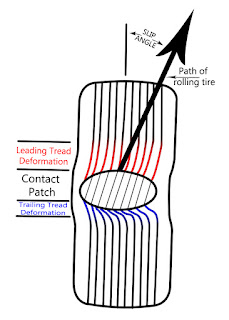
Everyone says that the best way to improve your car's handling, the best mod to do at the very beginning is and always is the tire. Good tires stand for excellent handling and bad tires mean terrible cornering. What is the story of tires and cornering? Cornering force vs slip angle In general when a car goes through a corner, there is a centrifugal force out there, and you could feel being thrown towards the outside. In order to successfully drive out the corner, the car would need some lateral force to help support the car push against that centrifugal force. That is the so called cornering force. Due to the cornering force as well as the acceleration force on the tire parallel to the tire direction, the force would be directed towards some angle from the tires' direction (assume that ideally all the tires have the same properties, which point to only one direction). The angle is the slip angle. You can notice obvious slip angles in any racing event when race cars mak...

Starter (engine)

Image
What is starter? The starter for the engine is definitely one of the key components of a car. Without a starter a car could never start working:  wikipedia: Starter_(engine) So we all understand the 4-stroke combustion engine mechanism, but have you ever asked yourself what triggers the working cycles of an engine? Or where is that energy from? (Of course from the battery.. but how?) In the old times, in order for the engine to start its strokes, we need manual human power to get the flywheel rotate. This could be harm to the car, dangerous to the person and in modern days with the advent of electric starters, we kick it off. Nice and easy. What is it composed of? This is what a start looks at in general: Starter There are two components in a start: a starter motor, the larger bottom cylinder and a starter solenoid, the smaller top cylinder: - The motor literally means the spinning object. This is where electric energy transfers into kinetic energy. - The soleno...